Treatment Examples
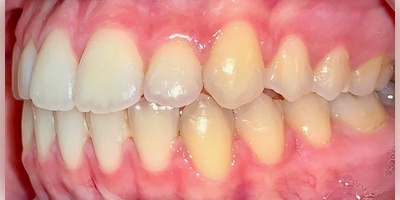
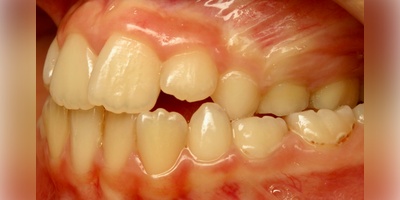
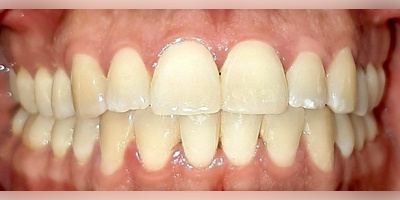
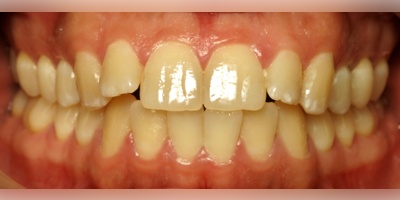
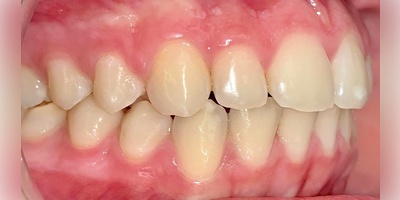
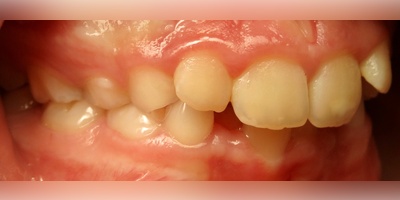
Every orthodontic treatment is unique, because every patient presents a dental and skeletal configuration that is entirely their own. The before and after photographs shown on this page illustrate results achieved at the OrthoClermont practice in Clermont-Ferrand by Dr Alexandra Normand. They provide a concrete idea of what orthodontic treatment can accomplish, whether it involves simple alignment or a more complex correction of the relationship between the jaws.
Most common cases
At the OrthoClermont practice, the most frequent reasons for consultation involve dental crowding (teeth overlapping due to lack of space), diastemas (gaps between teeth), jaw discrepancies (Angle Class II or Class III), open bites (lack of contact between the upper and lower front teeth) and deep bites (excessive overlap of the lower incisors by the upper incisors).
Each of these situations requires a different therapeutic approach. Mild crowding may be resolved in a few months with clear aligners, whereas a significant skeletal discrepancy in a growing child will require a functional appliance followed by multi-bracket treatment. It is the initial assessment, comprising a clinical examination, radiographs and a digital scan, that determines the most suitable technique.
How to read the before and after photographs
The photographs are taken under standardised conditions: same lighting, same angle, same retractors. The "before" image shows the situation at the start of treatment; the "after" image shows the result when the appliance is removed. It is important to note that these results are specific to each patient and depend on numerous factors: the severity of the initial problem, the patient's age, cooperation during treatment and individual biology.
Clinical photographs are taken with the informed, written consent of each patient (or their legal representative for minors). They are presented for informational and educational purposes, in accordance with professional guidelines.
Techniques used
The treatments shown below were carried out using a variety of techniques depending on the case: metal or ceramic multi-bracket appliances, clear aligners, lingual braces, functional appliances for growing children, or combinations of several techniques. In some cases, orthodontic mini-screws were used to enable movements that would not have been possible with conventional methods alone.
The choice of technique depends on the diagnosis, the patient's aesthetic preferences during treatment, and clinical requirements. Dr Alexandra Normand presents the different options at the initial consultation, along with the advantages and limitations of each, so that you can make an informed decision.
Retention: maintaining results
Orthodontic treatment does not end when the appliance is removed. The retention phase is just as important as active treatment: it aims to stabilise the teeth in their new position while the bone and periodontal tissues restructure. Without retention, teeth have a natural tendency to drift back towards their original position, this is known as relapse.
Retention can take several forms: a thin metal wire bonded to the inner surface of the teeth (discreet and permanent), a clear retainer worn at night, or a combination of both. The retention protocol is defined according to the clinical case and the risk of relapse specific to each patient.
Types of malocclusions treated
Orthodontics treats a wide range of dental and skeletal problems. Dental crowding, when teeth overlap due to insufficient space on the arch, is the most frequent reason for consultation. It can be mild, moderate or severe, requiring anything from simple alignment to extractions to create the necessary space.
Angle Class II malocclusions, characterised by an anteroposterior discrepancy between the upper jaw and mandible (the lower jaw sits too far back), represent a significant proportion of treatments. In growing children, a functional appliance can correct this discrepancy by stimulating mandibular growth. In adults, correction is achieved through dental compensation or, in the most severe cases, orthognathic surgery.
Class III malocclusions (lower jaw positioned too far forward relative to the upper jaw), anterior open bites, deep bites, crossbites and facial asymmetries are also regularly treated at the OrthoClermont practice.
Frequently asked questions about orthodontic results
Are the results permanent?
The results of orthodontic treatment are stable provided the retention phase following active treatment is respected. Without retention, teeth have a natural tendency to drift back towards their original position. Wearing a bonded retainer wire and/or a night-time retainer maintains the results long term.
At what age can treatment begin?
There is no age limit for starting orthodontic treatment. In children, a first consultation is recommended around age 7 to screen for potential growth problems. Multi-bracket treatments typically begin around age 11 to 12, once the permanent teeth are in place. In adults, treatment can be undertaken at any age, provided the periodontal tissues are healthy.
Can I see the result before starting?
With current digital technologies, it is possible to produce a 3D simulation of the expected result before treatment begins, particularly in the case of clear aligners. This simulation allows the patient to visualise their future smile and validate the treatment plan proposed by the practitioner.
Treatment for all ages
Orthodontic treatment is not limited to teenagers. At OrthoClermont, patients range from young children requiring early interceptive treatment to adults in their fifties and beyond seeking to correct long-standing alignment issues. For children, early intervention, typically between ages 7 and 11, can address skeletal growth discrepancies while the bones are still developing, potentially avoiding the need for surgery later. For adults, modern options such as clear aligners and lingual braces make treatment more discreet and compatible with professional life than ever before.
Book an appointment
If you would like to find out what orthodontic treatment could change for you or your child, please book an appointment at the OrthoClermont practice in Clermont-Ferrand. The initial assessment allows your situation to be evaluated, treatment options to be explained, and all your questions to be answered. Contact us by telephone at 04 23 32 47 37 or by email at contact@orthoclermont.com to arrange an appointment.
Treatment Examples
The OrthoClermont practice in Clermont-Ferrand handles the full range of orthodontic cases, from dental alignment to skeletal corrections. Here are some examples of treatments carried out by Dr Normand.