OUR TREATMENTS
Invisible Lingual Braces in Clermont-Ferrand | ODF
At the OrthoClermont practice in Clermont-Ferrand, Dr François Normand offers lingual orthodontics, a technique that places brackets on the inner surface of the teeth, making them completely invisible from the outside. This approach meets the growing demand from adult patients who wish to correct their smile without anyone in their professional or personal circle noticing. Lingual orthodontics combines the effectiveness of a fixed appliance with absolute discretion.
How lingual braces work
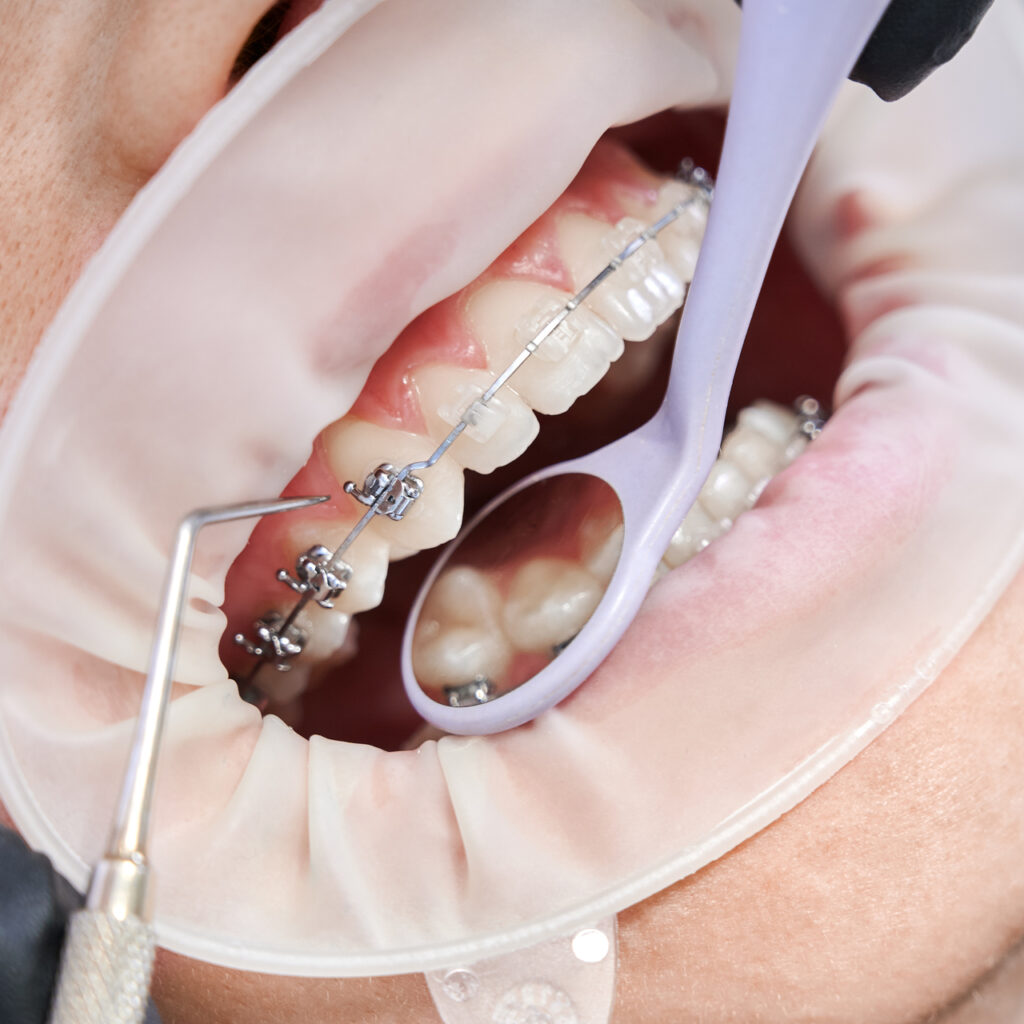
The mechanism is identical to that of conventional multi-bracket appliances: brackets connected by a metal archwire apply continuous forces to the teeth to move them into the desired position. The fundamental difference lies in bracket placement: they are bonded to the lingual surface (tongue side) rather than the vestibular surface (lip side).
This positioning creates specific technical challenges, as the inner surface of each tooth has a more complex and variable anatomy from patient to patient. This is why lingual brackets are custom-manufactured from high-precision digital impressions. Each bracket is individually designed using computer-aided design and manufacturing (CAD/CAM) to perfectly match the tooth surface, ensuring optimal fit and maximum comfort.
Technology used at the practice
The OrthoClermont practice uses the latest-generation lingual systems. The process begins with a three-dimensional intra-oral digital scan, which replaces traditional alginate impressions, a considerable improvement in patient comfort. The digital data is then sent to the laboratory, which manufactures the custom brackets and archwires.
The archwires are also robot-bent according to the digital treatment plan, ensuring placement accuracy to within a tenth of a millimetre. This complete digital workflow produces predictable, reproducible results comparable to the most advanced vestibular techniques.
Treatment process
At the first consultation, Dr François Normand carries out a complete orthodontic assessment including a clinical examination, radiographs, photographs and a digital scan. If lingual orthodontics is chosen, the digital data is sent to the laboratory for custom bracket manufacturing. This step generally takes three to four weeks.
The placement appointment lasts approximately one and a half hours. Each bracket is positioned using a transfer tray that guarantees precise placement. A flexible initial archwire is then inserted. Most patients experience some tongue discomfort during the first few days, as the tongue adjusts to the presence of the brackets. Speech may be slightly affected during this adaptation period, but returns to normal quickly, usually within two weeks.
Follow-up appointments are scheduled every four to six weeks. Each session is used to check movement progress, change archwires and adjust the treatment plan if necessary.
Advantages of lingual orthodontics
- Total invisibility: no one can detect the appliance, even at close range
- Fixed appliance: no risk of forgetting or losing it, unlike removable aligners
- Effectiveness comparable to vestibular braces for most orthodontic cases
- Custom brackets for perfect fit and optimised comfort
- No impact on the enamel of the visible tooth surface
- Suited to image-conscious professions (models, actors, salespeople, lawyers)
- Compatible with playing wind instruments, unlike vestibular appliances
Who is it for?
Lingual orthodontics is primarily intended for adults and teenagers who place discretion at the top of their priorities. It is particularly suited to patients whose professional activity involves regular contact with the public: teachers, salespeople, healthcare professionals, lawyers, journalists or performers. Musicians who play wind instruments also benefit, since the brackets are not in contact with the lips.
From a clinical perspective, lingual orthodontics can treat the vast majority of malocclusions: crowding, spacing, deep bite, open bite, jaw discrepancies. Some very complex cases may nonetheless be better managed with a conventional vestibular approach, Dr François Normand will guide you towards the solution best suited to your situation.
Daily comfort and adaptation
The adaptation period is often the main concern for patients considering a lingual appliance. In practice, the tongue adjusts to the presence of the brackets within a few days to two weeks. During this phase, certain sounds may be slightly altered, lingual consonants (t, d, n, l) are the most affected. Reading aloud exercises can accelerate the adaptation process.
Oral hygiene requires particular attention, as the lingual area is less accessible for brushing. The OrthoClermont practice provides suitable interdental brushes and specific hygiene advice for this technique. A water flosser is a very useful addition for maintaining impeccable hygiene throughout treatment.
Cost considerations
The cost of lingual treatment is higher than that of conventional vestibular braces, due to the custom manufacturing of brackets and the increased technical complexity of adjustment appointments. A detailed quote is provided at the initial consultation. For patients under 16, the social security contribution applies in the same way as for other techniques. For adults, some supplementary insurance plans cover part of orthodontic treatment, it is advisable to check your policy before starting treatment.
Frequently asked questions about lingual braces
Are lingual braces painful?
Placement is painless. Tongue discomfort and tooth sensitivity appear in the first few days, then diminish quickly. The discomfort is comparable to that experienced with a conventional vestibular appliance.
Can I eat normally with lingual braces?
Yes, by avoiding very hard and sticky foods as with any fixed appliance. The tongue adapts quickly and chewing becomes comfortable again within a few days.
Does lingual treatment take longer than conventional treatment?
No, the duration is comparable: between 12 and 24 months depending on the complexity of the case. Current custom-manufacturing technologies have considerably improved the efficiency of the lingual technique, which now rivals vestibular methods in terms of treatment speed.
Duration and retention
Lingual treatment duration ranges from 12 to 24 months depending on the severity of the malocclusion to be corrected. When the appliance is removed, a retention phase is put in place to maintain the results achieved: a bonded retainer wire on the inner surface of the teeth (already accustomed to the presence of brackets) and/or a night-time retainer. Post-treatment follow-up is provided by the OrthoClermont practice in Clermont-Ferrand to verify long-term stability of the results.
OUR OTHER SOLUTIONS
USEFUL INFORMATION