OUR TREATMENTS
Orthopaedic Devices for Children | Clermont-Ferrand
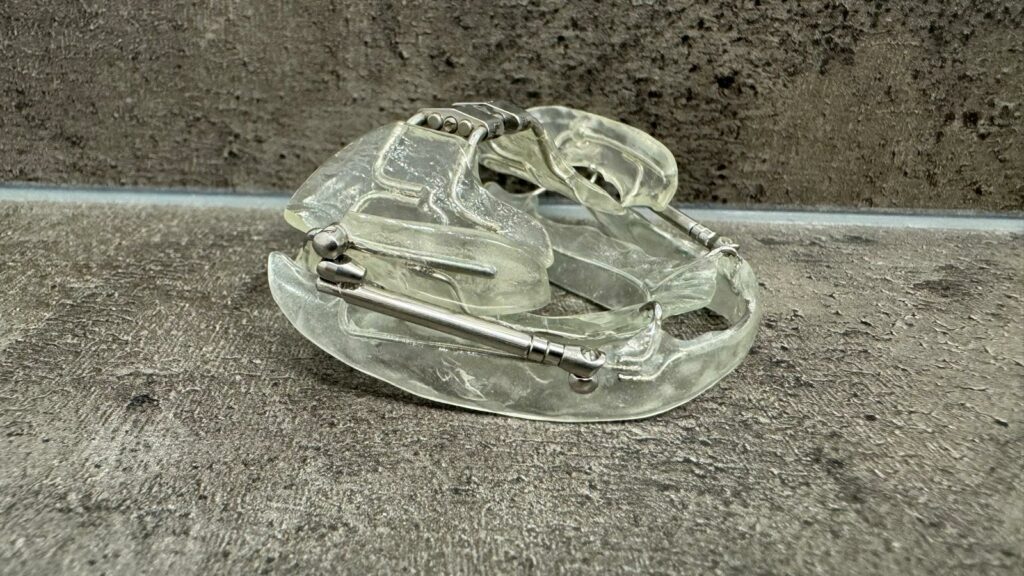
The OrthoClermont practice of Dr François Normand, orthodontist in Clermont-Ferrand, provides treatment with dentofacial orthopaedic devices. These appliances act directly on the growth and shape of the facial bones, the upper jaw (maxilla) and the lower jaw (mandible), to correct skeletal abnormalities that conventional braces alone cannot resolve. Dentofacial orthopaedics is a distinct discipline within orthodontics, one that addresses the bony architecture of the face rather than the position of individual teeth.
Orthodontics versus orthopaedics
Orthodontics moves teeth within the bone. Orthopaedics modifies the shape, size or position of the bones themselves. In practice, the two approaches are often complementary: orthopaedics corrects the bony framework, then orthodontics fine-tunes tooth alignment within that framework. This distinction is fundamental because skeletal problems, a palate that is too narrow, an upper jaw that protrudes too far forward or an underdeveloped mandible, cannot be resolved by tooth movement alone.
In children, bone growth is still active and the cranial sutures have not yet fused, making the bones receptive to orthopaedic forces. In adults, the same corrections can only be achieved surgically. This is why early diagnosis of these abnormalities is critical to the treatment outcome.
Main orthopaedic devices
The choice of device depends on the type of skeletal abnormality to be corrected. Dr François Normand selects the most suitable appliance for each patient's clinical situation:
- Palatal expander (rapid maxillary expansion): The most frequently used orthopaedic device. It corrects transverse maxillary deficiency, in other words, a palate that is too narrow. The appliance is fixed to the upper molars and features a central jackscrew that the parents activate daily using a special key. Within a few weeks, the midpalatal suture opens and the palate widens. The space created fills naturally with newly formed bone.
- Delaire face mask: Used to treat upper-jaw developmental deficiency (Class III due to maxillary retrusion). The mask rests on the forehead and chin, and elastics connected to a fixed intra-oral appliance pull the maxilla forward. It is worn mainly at night and for a few hours during the day, over a period of 6 to 12 months.
- Headgear (extra-oral force): A facebow connected to cervical or cranial traction exerts a backward force on the upper jaw or upper molars. This appliance restrains maxillary growth when it projects too far forward relative to the mandible. It is worn for several hours a day and at night.
- Quad-helix: A fixed slow palatal expansion appliance. Unlike the rapid expander, the quad-helix acts gradually over several months. It consists of four loops of wire soldered to molar bands. It is often preferred in very young children or when moderate expansion is sufficient.
- Chin cup: An extra-oral appliance that restrains or redirects mandibular growth when it is excessive (mandibular prognathism). It is worn at night and for a few hours during the day.
The palatal expander in detail
Rapid palatal expansion is one of the most common and most effective orthopaedic treatments in paediatric orthodontics. A palate that is too narrow leads to a cascade of problems: dental crowding, mouth breathing, sleep-disordered breathing in children, increased caries risk due to insufficient space for brushing, and sometimes chewing difficulties.
The protocol is well established: after placement of the expander (a session of approximately 30 minutes), the parents activate the jackscrew once or twice a day for two to three weeks. A gap between the upper incisors appears within a few days, this is a sign that the palatal suture is opening. This gap closes spontaneously over the following weeks. The appliance remains in place for three to six months after activation is complete, allowing the bone to consolidate in its new dimension.
In children aged 6 to 10, results are rapid and stable. After puberty, the palatal suture begins to fuse and expansion becomes more difficult to achieve, a further reason to consult early.
Treatment process at the practice
Treatment begins with a comprehensive assessment: clinical examination, panoramic radiograph, cephalometric X-ray (essential for analysing skeletal relationships), and sometimes a cone beam CT scan to evaluate bone density or the position of impacted teeth. Dr François Normand establishes a precise diagnosis and explains to the parents the nature of the problem, the therapeutic options and the expected timeline.
Device placement takes place during a dedicated session. For fixed appliances (expander, quad-helix), bands are cemented onto the molars and the device is fitted. Parents receive precise instructions for daily activation (in the case of the expander) and the hygiene measures to adopt. Follow-up appointments monitor expansion or correction progress and adjust the protocol as needed.
Benefits of early orthopaedic treatment
- Corrects skeletal imbalances without surgery by harnessing the child's growth
- Improves facial harmony: profile, symmetry, proportions
- Stable long-term results because the correction is skeletal, not merely dental
- Prevents orthognathic surgery in adulthood in many cases
- Improves nasal breathing (after palatal expansion) with benefits for sleep and quality of life
- Creates space for permanent teeth to erupt, reducing the risk of tooth impaction
- Treatment is often simpler and shorter when carried out at the right time
What is the ideal age?
The optimal age depends on the type of skeletal problem to be treated:
- Palatal expansion: ideally between ages 6 and 10, before the midpalatal suture fuses
- Class III (face mask): between ages 7 and 9, when the maxilla is set back relative to the mandible
- Class II (mandibular discrepancy): during the pubertal growth spurt, generally between ages 10 and 13
- Chin cup: during the active growth phase of the mandible
This is why a first consultation from age 6 to 7 is recommended by all orthodontists: it ensures the optimal therapeutic window is not missed, and intervention takes place when the bones are most receptive to treatment.
What happens after orthopaedic treatment?
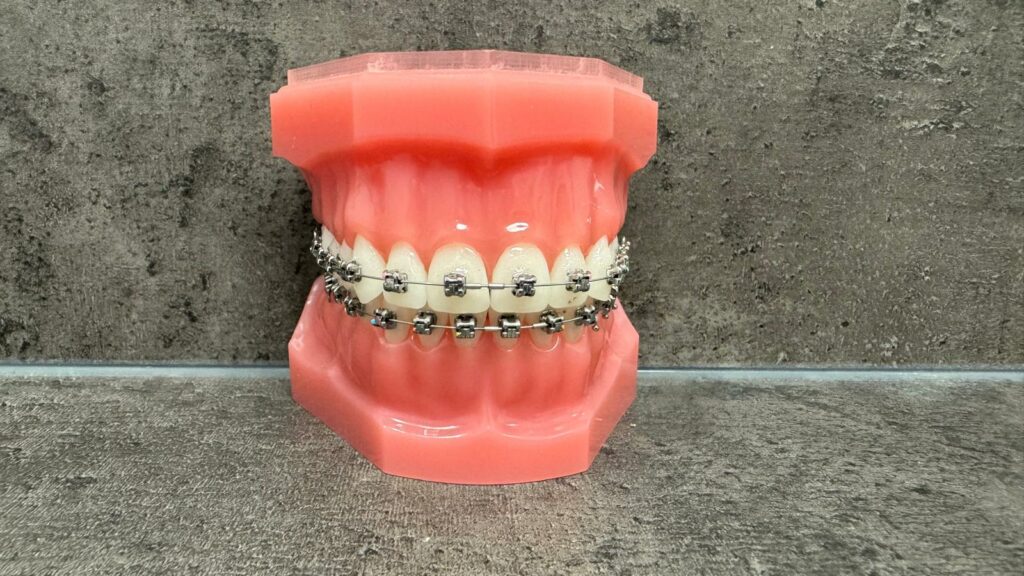
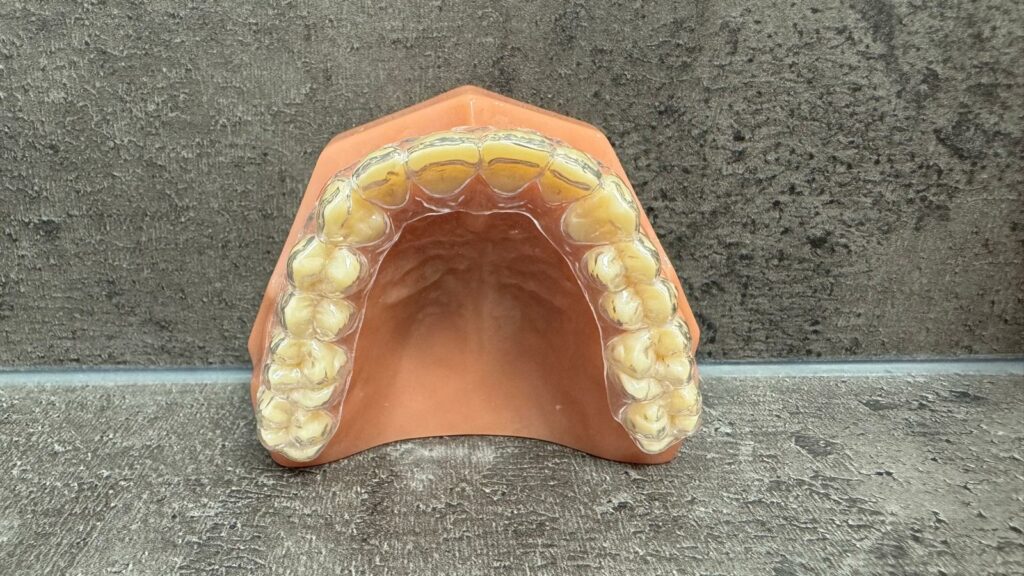
Once the bony framework has been corrected, conventional orthodontic treatment (multi-bracket appliances or clear aligners) is often scheduled as a second phase, once all permanent teeth are in place. This two-phase strategy is well established in orthodontics and produces complete, stable results at both the skeletal and dental levels.
In some cases, the orthopaedic correction alone is sufficient and no further orthodontic treatment is required. Dr François Normand re-evaluates the situation at the end of the orthopaedic phase to determine the next steps in care.
Treatment duration
The active orthopaedic phase generally lasts between 6 and 12 months, depending on the device used and the extent of the correction required. A retention period systematically follows active treatment to allow the bone to consolidate and stabilise the results. Regular follow-up is provided at the OrthoClermont practice in Clermont-Ferrand, at a frequency tailored to each case.
OUR OTHER SOLUTIONS
USEFUL INFORMATION